
Using Python MockServer for API Testing
Use Python requests with MockServer’s REST API to create expectations, test failure responses, verify calls, and reset state between tests.
Latest insights on API testing, performance optimization, and software development best practices from the Speedscale team.
Use Python requests with MockServer’s REST API to create expectations, test failure responses, verify calls, and reset state between tests.

Set performance regression baselines from repeatable workloads. Measure variation, preserve correctness checks, and compare delivered load and latency.
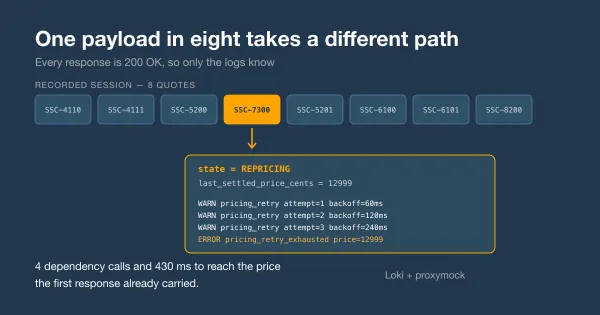
Find the rare payload that sends a service down a retry path, correlate it to the recorded response, and prove the fix with proxymock replay.

Test resilience with defined dependency faults, observable degraded behavior, stop conditions, and recovery criteria alongside representative load.

Test REST APIs with useful assertions, contract checks, controlled data, and test identities. Build a smoke test that fails for the right reason.

Scoped chaos rules are now in proxymock: pick traffic with a filter query, perturb it, and label every injected failure so it is never mistaken for a real one.
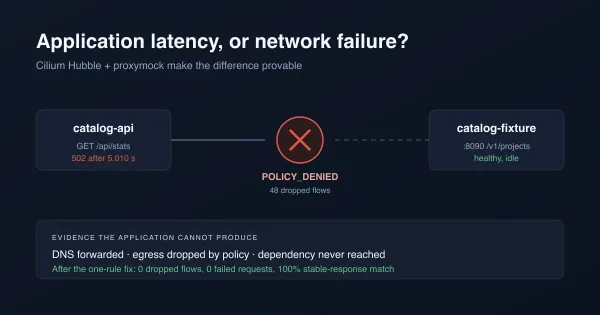
Use Cilium Hubble flow evidence and proxymock replay to prove whether a Kubernetes timeout came from your code, a dependency, or a dropped packet.

Capture API traffic with Speedscale, export a k6 load scenario, and mock backend dependencies in Kubernetes with speedctl or locally with proxymock.

Compare Gatling and Speedscale for Kubernetes load tests. Evaluate scripts, recordings, dependency isolation, and CI results alongside existing tests.