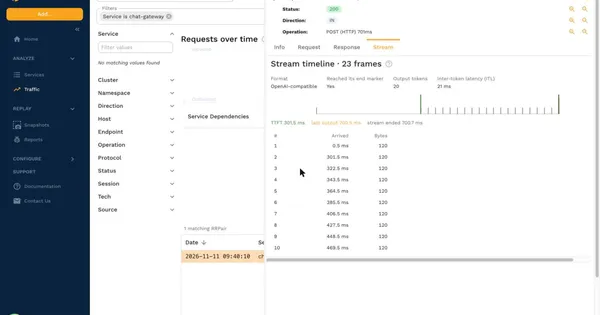
How to Measure TTFT and Inter-Token Latency With Recorded Traffic
Run the mock-lab LLM streaming lab: record streamed chat traffic with proxymock, replay it, and fail the run when TTFT or inter-token latency regresses.
Browse 48 posts in this category
Run the mock-lab LLM streaming lab: record streamed chat traffic with proxymock, replay it, and fail the run when TTFT or inter-token latency regresses.
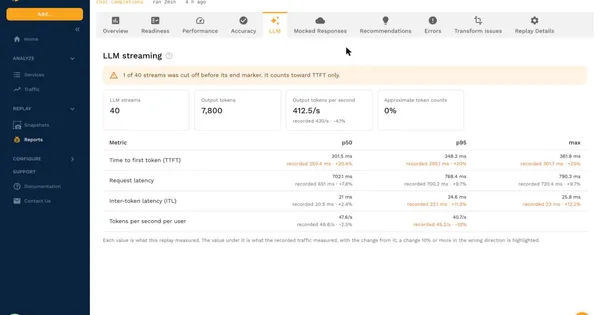
Speedscale replays now measure AIPerf-defined TTFT, inter-token latency and token throughput on your recorded LLM traffic, next to what production measured.
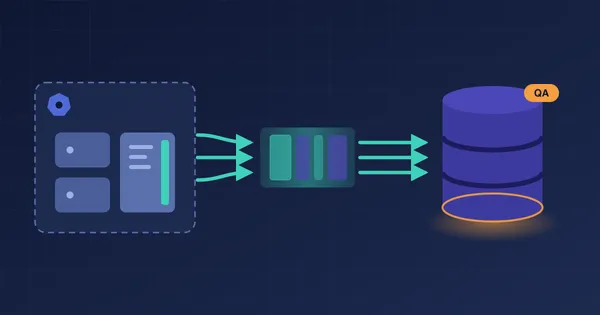
Record the queries your app sends to PostgreSQL in Kubernetes, then replay them against a QA database as a load and regression test. No scripts to write.

Add continuous performance tests to CI with bounded smoke checks and scheduled load runs. Choose meaningful gates and handle noisy results with baselines.

Choose API testing tools for exploration, CI regression, and dependency isolation. Compare assertions, protocols, workflows, and migration requirements.

Measure throughput with defined transaction boundaries, sustainable load stages, latency and error goals, and enough load-generator capacity.

Calculate TPS from completed transactions and a measured time window. Distinguish requests, business outcomes, retries, latency, and errors.

Compare GoReplay and Speedscale capture, TLS requirements, dependency mocks, and local or Kubernetes replay. Verify the exact workflow before choosing.

Test Kubernetes autoscaling with controlled load. Verify HPA metrics, readiness, scaling policies, and scale-down alongside latency and errors.
Choose the desktop proxymock or the hosted cloud trial to get started.