If you are leading an engineering organization today, you are likely feeling a profound friction. Your engineers are equipped with AI copilots, their individual velocity is spiking, and yet, your broader delivery lifecycle feels stubbornly slow.
The machinery of your software development lifecycle (SDLC) is groaning.
We are standing at the edge of the second great tectonic shift in software engineering history. To understand where we are going, towards what we call the AI Software Factory, we first have to understand where we’ve been, and why our current processes are failing under the weight of artificial intelligence.
The Ghost of Waterfall
Decades ago, the Waterfall methodology wasn’t just a bad management idea; it was a physical necessity.
In the 1990s and early 2000s, infrastructure was rigid. Provisioning a server meant ordering physical hardware, waiting weeks for delivery, racking it in a data center, and wiring it up. Because the deployment of software was highly constrained and expensive, the creation of software had to be heavily batched. You couldn’t afford to be wrong, so you spent six months planning, six months coding, and three months testing.
Infrastructure dictated process.
The Agile Revolution: Driven by the Cloud
Then came virtualization, the Cloud, and eventually microservices. Suddenly, infrastructure was elastic. You could spin up a server with an API call in seconds.
The physical constraints vanished, but a new problem emerged: Waterfall could not keep up with the speed of the Cloud. If infrastructure was “just-in-time,” the SDLC needed to be just-in-time, too.
Agile wasn’t born simply because developers wanted to work differently; it was born because the technical landscape demanded a process architecture that matched the elasticity of the new infrastructure. We traded monolithic release cycles for two-week sprints. We traded massive requirements documents for user stories.
The New Catalyst: Elastic Code
Today, we are repeating history, but the constraint has shifted.
The Cloud made infrastructure elastic. AI agents are making code generation elastic.
When an AI agent can ingest a natural language prompt and generate a React component, its TypeScript interfaces, and its Cypress tests in 45 seconds, the “cost” of writing code plummets toward zero. Code is no longer the scarce resource; it is an abundant, instantly available commodity.
And just as Waterfall broke when infrastructure became elastic, Agile is breaking now that code is elastic.
The Bottleneck Shift: When Agile Becomes Technical Debt
Think about the standard Agile workflow today. A Product Manager writes a Jira ticket. It sits in a backlog. It gets pointed in a sprint planning meeting. A developer picks it up, writes the code, submits a PR, waits for a human review, passes it to QA, and eventually, it deploys.
This process was designed to optimize human capacity. It was built to manage the cognitive load and typing speed of human engineers.
But when your “coding velocity” trends toward infinity because of AI, the bottlenecks immediately shift. The friction is no longer in writing the syntax; the friction is the Agile process itself.
- Why hold a two-hour sprint planning meeting to estimate “points” for a task an agent can complete in three minutes?
- Why wait for a two-week sprint boundary to release a feature that was generated, tested, and validated in an afternoon?
In an AI-native world, Jira tickets and two-week sprints are rapidly becoming process-level technical debt.
The AI Software Factory: From Tasks to Intent
The fundamental shift we are navigating is the move from a task-based SDLC to an intent-based Factory.
In Agile, we manage tasks. We break down large goals into microscopic units of work (stories, tasks, sub-tasks) and track humans as they complete them.
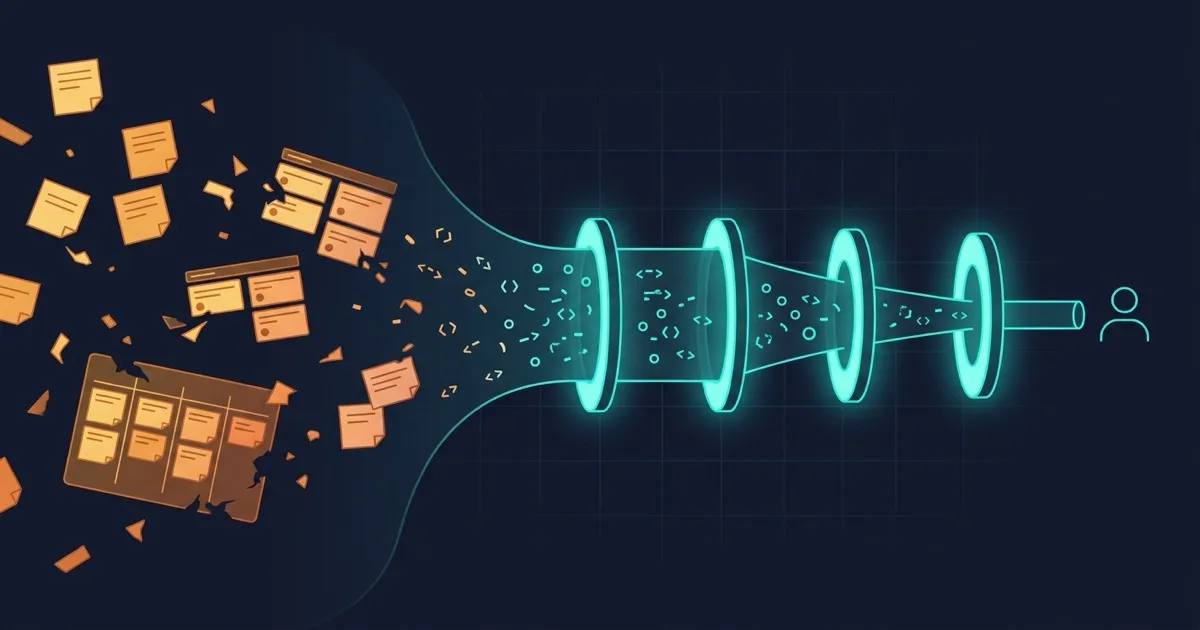
In the AI Software Factory, we manage intent through what we call the Funnel of Increasing Trust.
In this new model, velocity is not just a function of how fast code is written, but how effectively we filter it. We replace the traditional “Human-First” PR process with a series of increasingly expensive, increasingly rigorous automated gates:
-
Level 1: The Silicon Reflex (Unit Tests & Lints): The generative LLM self-validates against basic requirements and style. It runs the unit tests it just wrote, fixes its own lint failures, and re-attempts when something compiles but fails. This is the cheapest gate in the funnel and catches the largest volume of obvious issues (typo-level bugs, missing null checks, broken imports) before any other system has to spend a cycle on them. What gets through: anything that compiles and passes the LLM’s own self-conceived tests, which can include hallucinated APIs and confidently wrong business logic.
-
Level 2: The Silicon Critic (Adversarial LLMs): A secondary, “critic” model (like CodeRabbit, Codium PR-Agent, or Greptile) reviews the diff with a different prior than the model that generated it. The critic isn’t trying to ship; it’s trying to break. It flags security smells (SQL injection, missing authn checks), unhandled edge cases, and patterns the generator’s training rewards but real codebases punish. Using a different model is the point: same model, same blind spots. What gets through: anything that is logically valid but contextually wrong, because both models are reasoning about the code, not observing the system it lives in.
-
Level 3: The Deterministic Gauntlet (Traffic Replay & E2E): The code is subjected to “hard” tests built from real production behavior: traffic replay from production, deterministic evals, and full Playwright suites. This is the first gate that doesn’t share AI blind spots, and it’s where the most embarrassing regressions get caught. An LLM rewrites a request handler, passes Levels 1 and 2 cleanly, then fails replay because the response shape silently changed and a downstream consumer breaks. Or the new code path quietly introduces an N+1 that only surfaces under a specific query pattern from yesterday’s traffic. Determinism is the feature here. When this gate fails, you get a reproducible failure, not a probabilistic suggestion.
-
Level 4: The Carbon Gate (The Human): Finally, the human reviewer, the most expensive resource in the factory, reviews the high-order architecture and business logic. By the time work reaches a person, syntax errors, security smells, and behavioral regressions have already been filtered. The human is no longer reading the diff line by line; they are asking whether this code belongs in this service at all, whether it solves the right problem, and whether it locks the team into a decision that will hurt in six months. The role shifts from gatekeeper to architect.
flowchart LR
    Gen[AI Agent<br/>generates code] --> L1
    L1[Level 1<br/>Silicon Reflex<br/>Unit + Lint] -->|compiles, self-tests pass| L2
    L1 -.->|own errors| Gen
    L2[Level 2<br/>Silicon Critic<br/>Adversarial LLM] -->|logically valid| L3
    L2 -.->|security, edge cases| Gen
    L3[Level 3<br/>Deterministic Gauntlet<br/>Traffic Replay + E2E] -->|production-safe| L4
    L3 -.->|contract drift, regressions| Gen
    L4[Level 4<br/>Carbon Gate<br/>Human Architect] --> Prod[Ship to production]
    L4 -.->|architectural concerns| Gen
The goal of the Factory is simple: the fewer things that reliably make it to the human, the higher the velocity of the organization. When the human is the last gate, not the first, your leadership focus shifts from “Are we working?” to “Is the factory’s validation engine rigorous enough?”
But here is the catch: none of this works in a vacuum.
For an AI agent to self-validate, or for an adversarial LLM to critique effectively, or for a human to make a final architectural decision in minutes instead of days, they all require perfect information.
This necessitates a Unified Context Layer. We can no longer afford to have product intent locked in Jira, code in GitHub, test results in Jenkins, and real-world behavior in Datadog. For iteration to be instantaneous, we need a continuously enriched repository of context (artifacts from product inception, development, testing, and real-world execution) available simultaneously to both human and silicon actors.
In Part 2 of this series, we dive into the anatomy of this new Software Factory. We explore how toolchains are converging to create this Context Layer, the technical implementation of “Silicon Gates,” and why the “Sprint” is dead, replaced by the continuous pulse of the “Bolt.” See also our companion piece on Conway’s Law in the AI Factory for how org structure must mirror these new pipelines.