Every technology cycle comes with hype, backlash, and eventually… utility. AI is shaping up to be no different. As we head into 2026, the conversation is already shifting from “AI will replace everything” to “why isn’t this paying off yet?”
This shift is heavily influenced by evolving market trends, as businesses and technologists respond to changes in customer behavior, operational patterns, and broader market conditions that shape expectations around AI.

That tension is healthy. Ai is not exactly like the internet, smartphones or cloud revolutions but the music definitely rhymes.
Below are my 2026 AI predictions or some might say hot takes. But these observations are grounded in what we’re seeing inside real engineering organizations that care about reliability, delivery speed, and business outcomes.
The AI Bubble Will Pop. Long Live AI.
Let’s get this out of the way: the AI bubble will “pop.”
But what people mean by that is wrong.
A bubble, technically, is capital flowing into assets with no realistic path to value. That was the dot-com bubble and outside of a few winners like Amazon, most of these businesses were built on fundamentally broken economics.
What’s happening in AI today is something else entirely.
This is front-loaded capacity investment.
We are massively over-deploying GPUs, inference clusters, and foundation model infrastructure ahead of near-term business value. When expectations reset, people will call that a “bubble pop.” In reality, it’s a timing mismatch, not a value collapse.
The closest historical analogy probably is the dark fiber in the early 2000s vs the dot com bubble. Telecom companies laid far more fiber than demand required at the time. Investors panicked. Then… the internet caught up. Video streaming, cloud computing, mobile and whatever is on the horizon ate all of that capacity and more.
AI infrastructure will follow the same curve.
So yes, some AI startups will die. Valuations will compress. CapEx spending will slow. But the underlying technical trajectory remains intact. The capacity will get used—it’ll just take longer than the pitch decks promised. AI companies are already adapting their strategies to navigate the current investment environment and optimize capacity deployment for long-term growth. NVIDIA may not retain monopoly pricing power, but the future is full of inference.
Product Managers Will Become First-Level Designers, Engineers, and AI Agents
Now let’s get really tactical. The PM role is about to get much more powerful and more accountable. PM has typically been a thankless job somewhere between strategy and implementation, customers and engineers, feast and famine.
With vibe coding tools, AI prototyping, and agentic workflows, product managers can now directly realize far more of their vision. The code isn’t in production-ready form and unlike previous “PowerPoint engineering” this type of prototyping produces working, testable artifacts. AI-powered prototyping tools now enable PMs to participate directly in writing code, expanding their ability to create and refine functional prototypes.
PMs will:
- Build interactive prototypes
- Create initial workflows
- Explore edge cases without waiting for engineering cycles
This doesn’t replace engineers. Production systems still require serious software engineering: performance, security, reliability, scale.

But the center of gravity shifts because PMs with high agency can take control.
The result? Faster feedback loops, clearer intent, and fewer “that’s not what I meant” meetings.
PM importance grows not because engineers matter less, but because vision gets closer to execution.
AI Coding Agent Assistants Will Hit the Mainstream
AI coding assistants quietly went from zero to $2B in revenue in a couple of years. That doesn’t happen without real value. But in the confusion something is getting lost, these tools are just getting started but they aren’t magic. Modern AI coding assistants are powered by large language models, which enable them to understand and generate code in natural language.
In 2026, coding assistants will:
- Become standard tooling (like IDEs and GitHub)
- Be expected by default, not debated
- Improve developer throughput meaningfully
At the same time, teams will finally internalize their limits. Coding agents are great at:
- Boilerplate
- Pattern repetition
- Translation across languages and frameworks
Many coding assistants use a reflection pattern, where the agent critiques and refines its own code outputs through iterative self-feedback to improve accuracy and efficiency.
Unfortunately for our AI overlords, the coding assistants are also terrible at:
- System-level reasoning
- Architectural tradeoffs
- Knowing what shouldn’t exist
Mainstream adoption won’t come from perfection, it’ll come from habit. Just like autocomplete, just like CI, just like code review tools. This is lost on many larger organizations because it’s early days and it’s easy to conflate terrible use cases with genuinely useful ones. However, it’s coming. I know because it’s already happened at my startup and many others.
Types of AI Agents
As AI becomes more deeply embedded in business operations, understanding the different types of AI agents is crucial for building effective agentic AI workflows. Not all AI agents are created equal—each type brings unique strengths to the table, enabling organizations to automate processes, tackle complex tasks, and optimize performance with minimal human intervention.
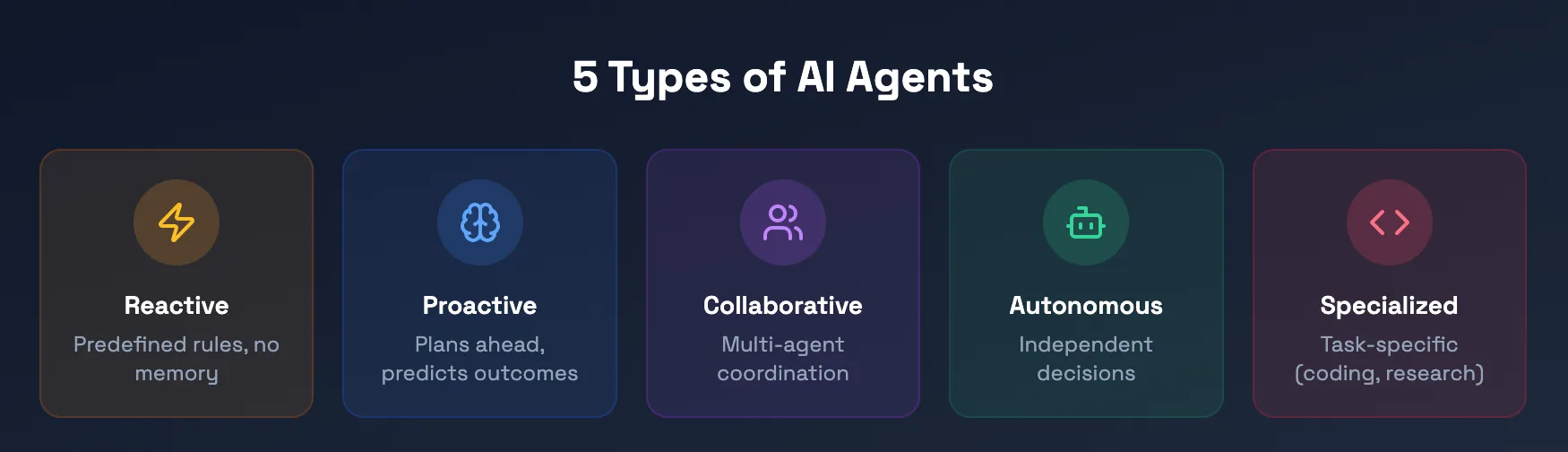
1. Reactive AgentsThese are the simplest form of AI agents. Reactive agents operate based on predefined rules and respond to specific inputs without memory or learning capabilities. They excel at handling repetitive tasks and straightforward decision-making, making them ideal for automating routine operations in agentic workflows.
2. Proactive (Deliberative) AgentsProactive agents go a step further by planning ahead and making decisions based on goals and available data. They can analyze situations, predict outcomes, and adapt their actions accordingly. This makes them valuable for more complex processes, such as dynamic resource allocation or real-time data analysis in cloud-native environments.
3. Collaborative (Multi-Agent) SystemsIn multi agent systems, multiple agents work together—sometimes with other agents, sometimes with human teams—to accomplish tasks that are too complex for a single agent. These systems enable agentic workflows where agents can negotiate, share information, and coordinate actions, streamlining operations and solving complex problems that require multi agent collaboration.
4. Autonomous AgentsAutonomous agents are designed to operate independently, making decisions and executing tasks without ongoing human oversight. They leverage advanced machine learning models and natural language processing to adapt dynamically as circumstances change. Autonomous agents are key to enabling intelligent workflows that can handle everything from customer segmentation to regulatory compliance with minimal manual intervention.
5. Specialized AgentsSome AI agents are built for specific tasks—think coding agents that write and debug code, research agents that perform deep research and synthesize findings, or agentic research assistants that automate data gathering and analysis. These specialized agents are increasingly integrated into AI workflows to boost productivity and accelerate decision making.
By leveraging the right mix of these AI agent types, organizations can design agentic AI workflows that not only automate simple tasks but also orchestrate more complex, adaptive, and intelligent business processes. As agentic AI continues to evolve, expect to see even more sophisticated agents—capable of self improvement, continuous learning, and seamless tool use—reshaping how teams build, test, and deliver software in 2026 and beyond.
Software Delivery Toolchains Will Rebuild Around Agentic AI Workflows and Determinism
This is the one most people are underestimating.
If an AI coder produces enormous quantities of buggy code, the solution is not “another AI”. That’s just more stochastic reasoning stacked on top of stochastic reasoning. Try out the latest and greatest “bug fix” products that utilize AI. Once you get over the amazement at what it can do with static reasoning you will eventually realize that noise scales to more noise. To truly scale engineering you need to introduce determinism. Unlike traditional automation, which relied on fixed, predefined rules and lacked adaptability, new deterministic AI-native pipelines are designed to be flexible and dynamically respond to complex scenarios.
In 2026, AI-native software delivery pipelines will rebuild themselves around:
- Concrete rule systems
- Traffic replay
- Sandboxing environments
- Deterministic validation gates
- Strong observability feedback loops
Think less “AI reviewing AI code” and think more “prove this works under real conditions.” For vibe coders and those building basic CRUD apps, this will increasingly come from LLM vendors themselves, in the same way Heroku abstracted infrastructure:
- Opinionated environments
- Guardrails baked in
- Limited but safe paths to production
For enterprises, the revolution is slower—but deeper. Software engineers will move up the abstraction stack:
- Less line-by-line code review
- More focus on curating gates
- Designing validation systems instead of eyeballing diffs
CI, observability, and even ticketing systems won’t disappear but they will become the core control plane for AI-generated software. Once again, I know because it’s already happening at smaller companies at smaller scale.
5. AI Will Disrupt Business Applications—But Not the Way People Expect
LLMs themselves are not getting dramatically better year over year. That phase is slowing.
So where does innovation go? Into applications.
The first wave will try to rebuild Salesforce with AI. Most of them will fail.
In the early days of the internet, Craigslist copied newspaper classifieds into HTML It worked, but it wasn’t the real disruption because it was a copy of an existing solution that was not optimized for the internet. The real winners rethought the problem with reputation systems, social proof and other internet-native trust signals (looking at you reddit).
The same thing will happen in enterprise software. The real disruption won’t come from “CRM, but with AI.” It will come from companies that rethink workflows from first principles, assuming:
- Automation is cheap
- Interfaces are conversational
- Data entry is passive
- Software adapts to users, not the other way around
That’s where incumbents get unseated and that transformation hasn’t really begun yet.
Bonus Hot Take: Companies Will Stop Training Their Own Large Language Models—and Still Be Disappointed
In 2026, most companies will finally stop trying to train their own LLMs.
They’ll move toward:
- Agent platforms
- Workflow tools like n8n
- AI “employees” glued together with prompts
These solutions are powered by advanced AI models and generative AI technologies, which enable more flexible, intelligent, and creative automation.
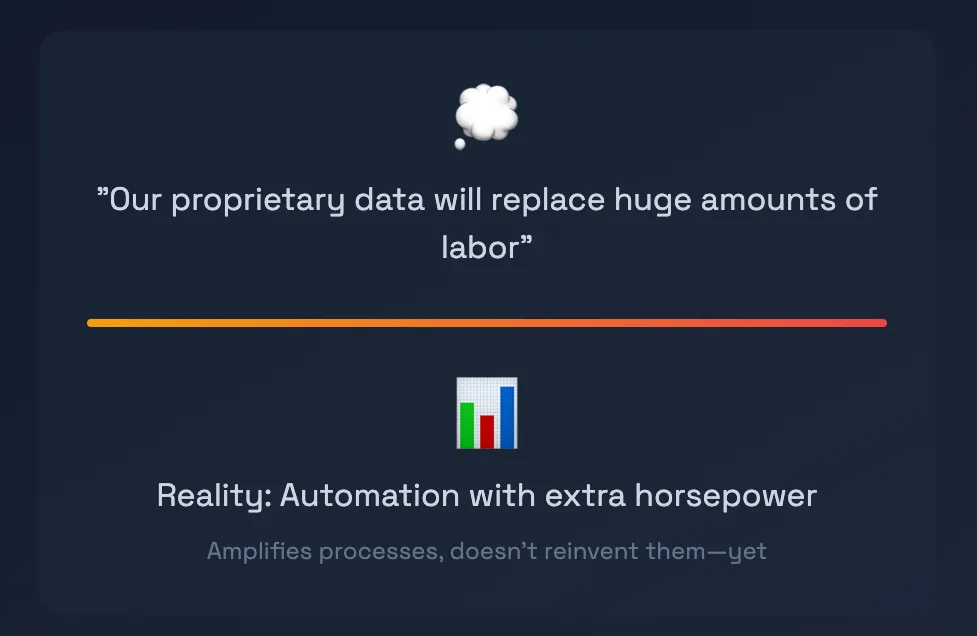
And… it still won’t work the way they hope. For years, companies have been told their proprietary data is incredibly valuable. That’s true but it’s led to a flawed conclusion:
that custom model training will replace huge amounts of labor.
Studies are increasingly showing that this doesn’t pan out.
Why?
Because relying solely on proprietary training data limits the effectiveness of AI solutions, as large language models depend on vast and diverse datasets for accuracy and adaptability.
Because current-generation AI is better understood as automation with extra horsepower, not a fundamental rethink of work.
It amplifies processes.
It doesn’t reinvent them—yet.
That deeper shift may come.
But not in 2026.
The Bottom Line
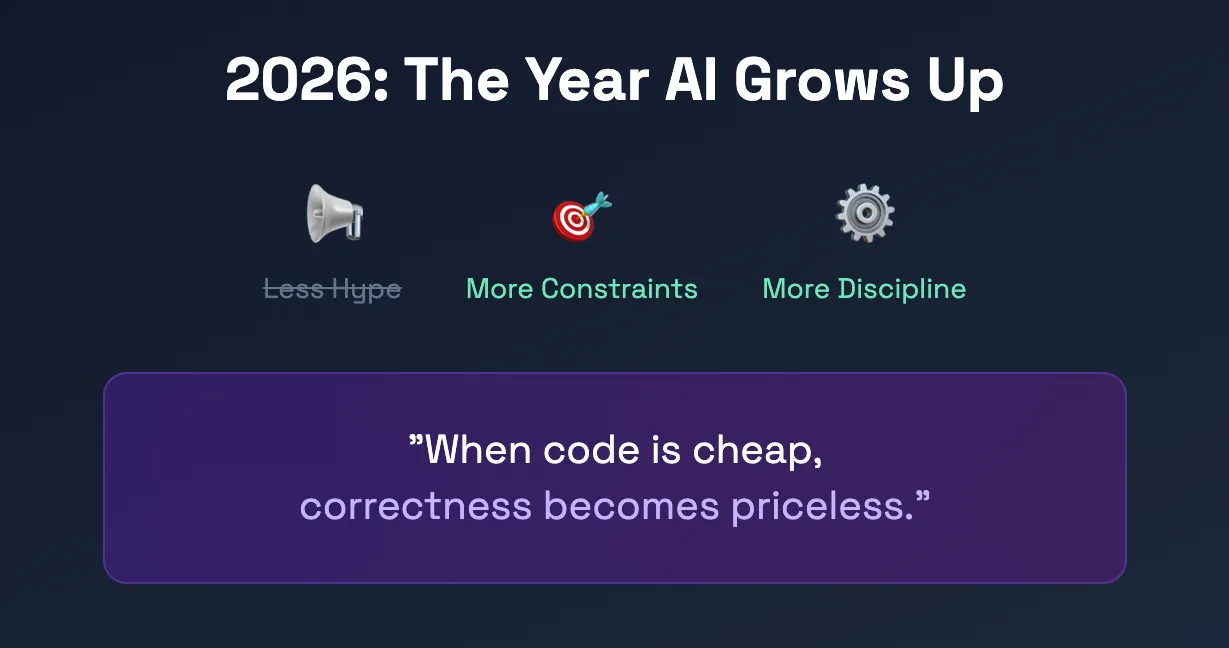
2026 is not the year AI “wins.”
It’s the year AI grows up.
Less hype.
More constraints.
More discipline.
And for teams that understand CI, testing, and delivery rigor, that’s not a threat—it’s an opportunity.
Because in a world where code is cheap, correctness becomes priceless.