The pitch for AI coding was speed. Claude Code, Copilot, Cursor, whatever you’re running, they all generate business logic faster than you can review it. That part is real. But look at what happens after the code gets written and the numbers get ugly.
CircleCI’s 2026 State of Software Delivery Report found AI drove a 59% increase in average throughput. Then it found main-branch throughput for the median team actually dropped 6.8%, and workflow success rates hit their lowest point in over five years.
“The data points to a clear conclusion: success in the AI era is no longer determined by how fast code can be written. The decisive factor is the ability to validate, integrate, and recover at scale.”
So we write code at machine speed and validate it at human speed. The bottleneck moved. It didn’t disappear.
Why observability alone leaves you blind
Say an agent refactors an API in ten seconds. How do you know it won’t take down production? The usual answer is you merge it and watch Datadog. But your APM is reactive by design. It tells you when a service falls over. It can’t stop the bad code from shipping in the first place.
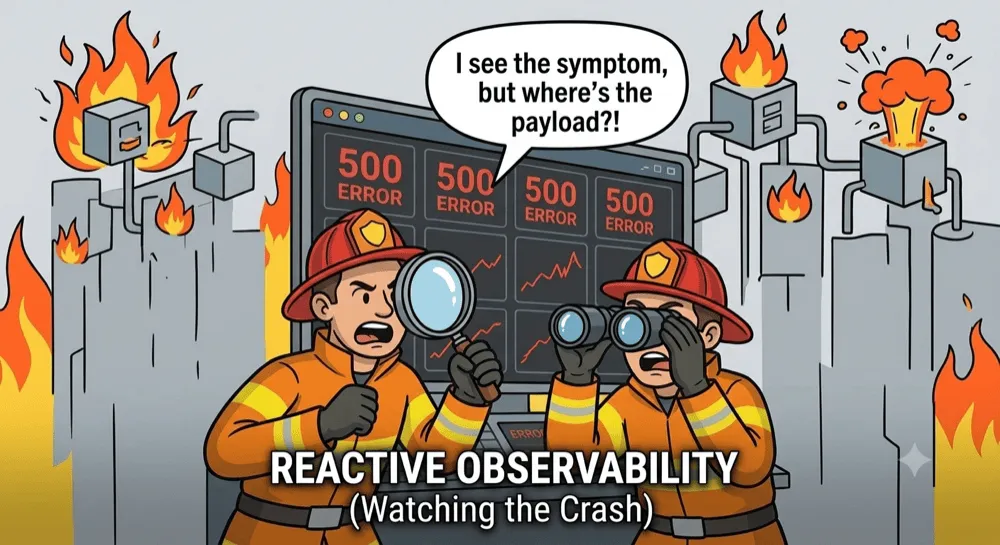
There’s a deeper problem. Most APMs can’t reproduce anything, because they never captured the traffic itself:
- No payloads. To keep storage costs down, APMs drop the actual request and response bodies. When AI-generated code breaks on some nested JSON field, a 500 trace with no payload just tells you something failed. You still have to guess where.
- No inter-service detail. Your APM knows Service A calls Service C. It doesn’t capture the exact sequence and content of that call. You can watch the failure cascade and still have no way to recreate it.
- A dashboard isn’t a repro. A latency spike on a graph is not the headers, auth tokens, and exact payload you need to pull the bug onto your laptop and actually fix it.
The result is that your users end up doing your QA. AI changes break more often and take longer to fix, so more of that breakage reaches production before anyone catches it.
Feed production traffic back into pre-prod
The move is to connect what production already knows to the code that hasn’t shipped yet. CircleCI’s data says this is possible:
“A small minority of teams demonstrated that change volume and delivery stability can scale together, proving that with the right systems in place, AI can accelerate work across the entire delivery pipeline.”
That’s the gap Speedscale closes. Instead of leaving production telemetry to sit in a dashboard, we feed it back into your CI/CD pipeline. A lightweight eBPF collector runs alongside your APM like a flight data recorder and captures the real traffic profile: the full payloads and the multi-service dependencies your APM throws away.
When an agent opens a pull request, Speedscale redacts the PII and replays that exact production traffic against the new code in an isolated container. You find out before the merge instead of after.
flowchart LR
    A[Production traffic] -->|eBPF capture| B[Real payloads and dependencies]
    B -->|redact PII| C[Traffic snapshot]
    D[Agent opens PR] --> E[Replay in isolated container]
    C --> E
    E --> F{Diff vs production}
    F -->|pass| G[Merge]
    F -->|latency or errors| H[Fix before merge]
You get proactive checks in place of reactive alerts. External dependencies like payment gateways and LLM calls get mocked automatically from real historical traffic, so there’s no hand-written mock to maintain. And the PR comes back with a real diff: under live load, this change added 14% latency. That’s a number you can act on before you hit merge.
Turning generated code into shipped value
AI amplifies whatever delivery process you already have. If shipping is already messy, generating more code faster just gives you more mess, faster. The teams pulling ahead are the ones that can validate what the agents produce and ship it with confidence. Writing the code was never the hard part, and now it’s basically free.
Put production traffic context into the development loop and the integration guesswork goes away. The engineer, or the agent, gets to hit merge knowing the thing actually works.