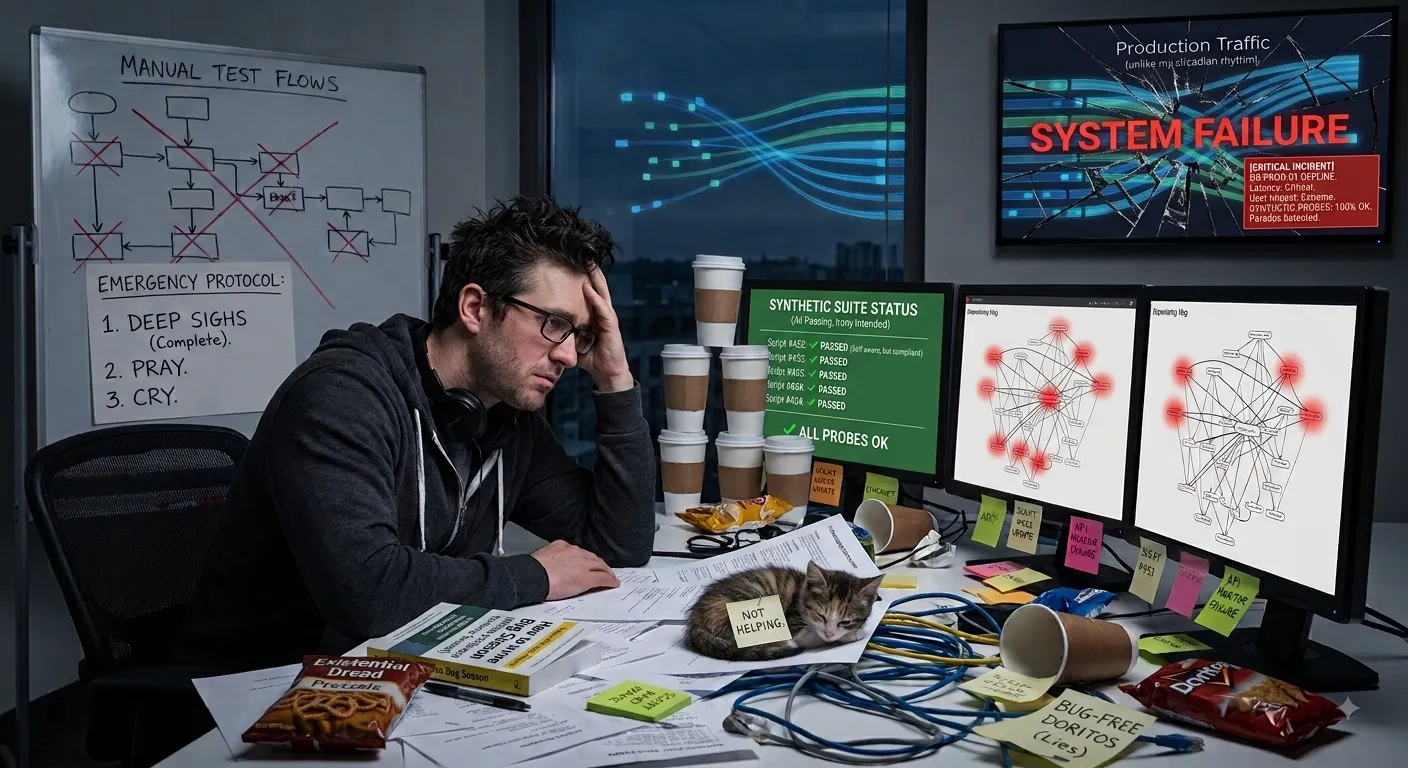
Synthetic Monitoring Is Broken. Your Production Traffic Can Fix It.
Synthetic monitoring has been a critical part of application reliability for years. It gives engineering and operations teams a way to proactively test applications, APIs, and critical customer journeys before users encounter problems.
But there is a fundamental limitation with the traditional approach:
Someone has to create the tests.
As applications become more distributed and customer journeys become more complex, organizations can end up maintaining hundreds or even thousands of synthetic scripts. Every new feature, API, dependency, or change to a customer journey can require another update.
And despite all that effort, synthetic tests can still miss the scenarios that matter most.
What if the answer isn’t writing more synthetic tests?
What if the answer is to let real customer behavior create them for you?
1. Why Real Transactions Create Better Synthetics
Traditional synthetic monitoring starts with an assumption: engineers know which customer journeys are important and can manually define those journeys as scripts.
That approach works well for a handful of critical workflows. But it becomes difficult to scale.
Modern applications aren’t simple websites with a few predictable paths. A single customer action can trigger dozens of API calls across multiple microservices, databases, third-party services, and infrastructure components. Customers can also take paths that engineers never anticipated.
This is where real production transactions become incredibly valuable.
Instead of guessing which scenarios should be tested, organizations can observe what customers are actually doing. Production transactions represent real application behavior, including the complex interactions and edge cases that are difficult to capture with manually written scripts.
Traditional synthetics are typically engineer-created, limited, static, maintenance-heavy, and based on assumptions.
Production-derived synthetics can be customer-driven, broad in coverage, continuously evolving, and based on actual behavior.
The difference is significant.
Rather than building a synthetic test suite once and continually maintaining it, organizations can create a testing system that evolves alongside their customers and their application.
2. Your Customers Are Already Writing Your Tests
Think about what happens every time a customer uses your application.
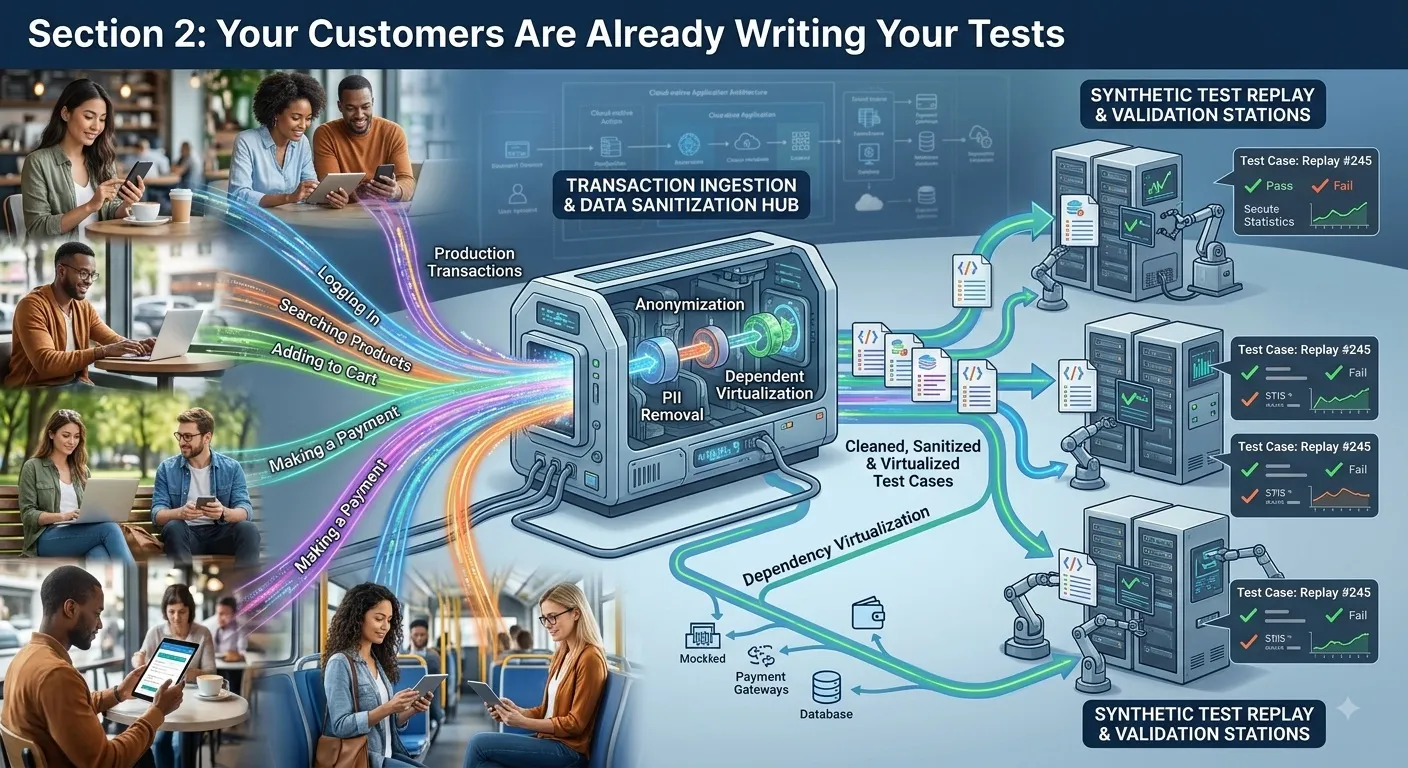
They search for a product. They log in. They add something to a cart. They submit an order. They make a payment. They call an API. They interact with multiple services.
Every one of those actions generates a transaction.
And those transactions are essentially real-world test cases.
The problem is that most organizations don’t treat them that way.
Instead, engineering teams spend time deciding which scenarios to turn into synthetic scripts. They write the scripts, maintain them, troubleshoot them when they break, and update them as the application changes.
Meanwhile, thousands of real customer transactions are happening every day.
Why manually create synthetic scenarios when your customers are already creating them for you?
The opportunity is to capture representative transactions, remove or transform sensitive information, virtualize dependencies where necessary, and replay those transactions safely outside of production.
A transaction that happened once in production can become a test that runs hundreds or thousands of times.
More importantly, the test isn’t based on what an engineer thinks a customer might do.
It’s based on what a customer actually did.
This changes the economics of synthetic testing.
Instead of continually investing engineering time into expanding and maintaining a library of synthetic scripts, organizations can build that library from the behavior their customers are already generating.
3. The Observability + Synthetics Opportunity
This creates a significant opportunity for observability platforms.
Observability companies already have a tremendous amount of information about how applications behave. They can see which services are being used, which transactions are important, where latency is increasing, and where failures are occurring.
But identifying a problem is only part of the equation.
The next question is:
Can we reproduce and continuously test the transaction that matters?
Imagine an observability platform identifying a critical customer transaction that is experiencing increased latency.
Instead of simply creating an alert, that transaction could become a synthetic test.
The transaction could be captured, sanitized, replayed against a test environment, and continuously executed to determine whether a future release or infrastructure change introduces the same problem.
This creates a powerful feedback loop:
Real Customer Behavior → Observability → Identify Critical Transactions → Generate Synthetics → Continuous Validation
This is where a partnership between an observability platform and a transaction-replay platform like Speedscale becomes compelling.
The observability platform provides the intelligence to understand which transactions matter.
Speedscale can provide the technology to capture, transform, replay, and virtualize those transactions so they can become realistic synthetic tests.
Together, the platforms can move synthetic monitoring beyond simple availability checks and predefined scripts toward something much more representative of the actual customer experience.
The Future of Synthetic Monitoring
Synthetic monitoring doesn’t need to become another endless collection of scripts that engineers have to maintain.
It can become a continuously evolving representation of how customers actually use an application.
The most valuable synthetic test may not be the one an engineer spends hours designing.
It may be the transaction a customer generated yesterday.
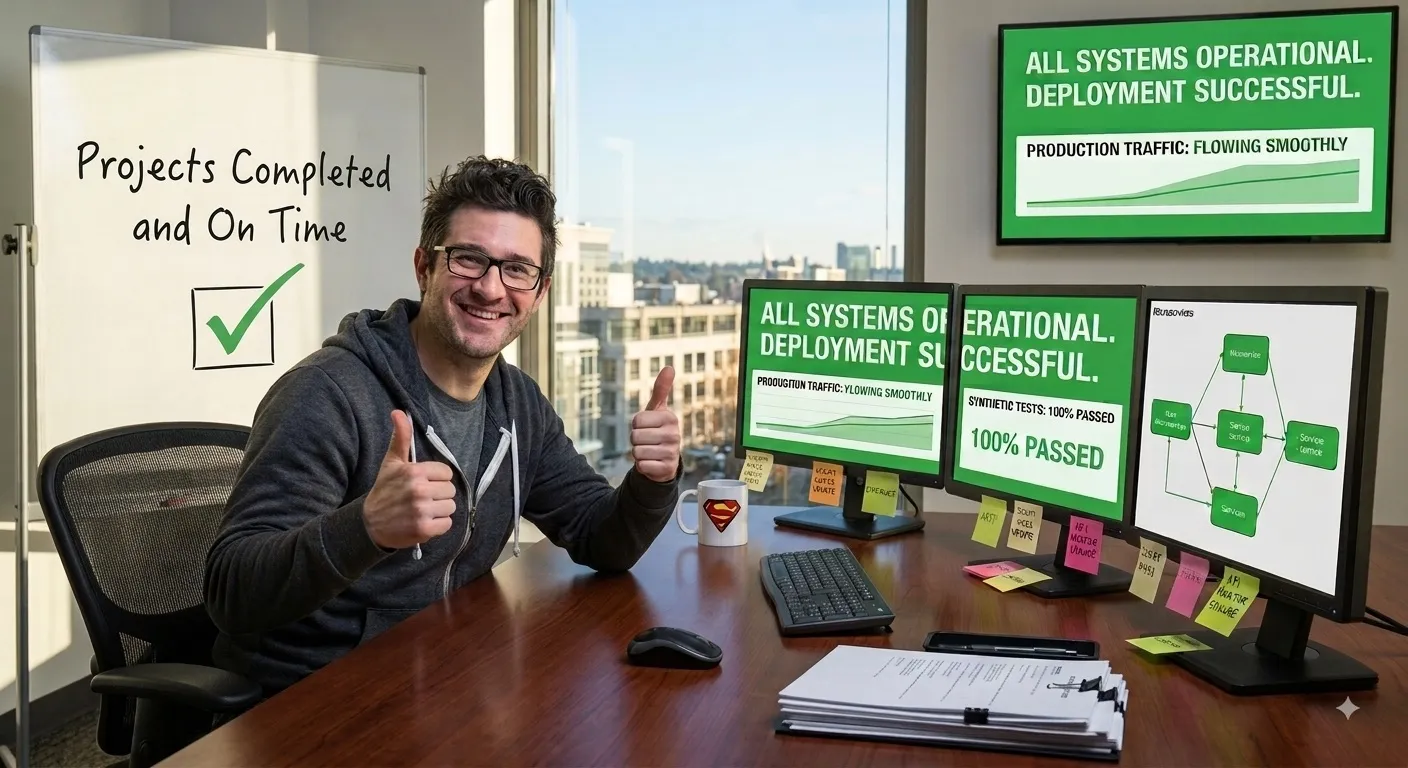
The future of synthetic monitoring is better tests: tests built from real customer behavior, continuously validating the experiences that matter most.
Your customers are already writing your synthetic tests. The opportunity is to start using them.